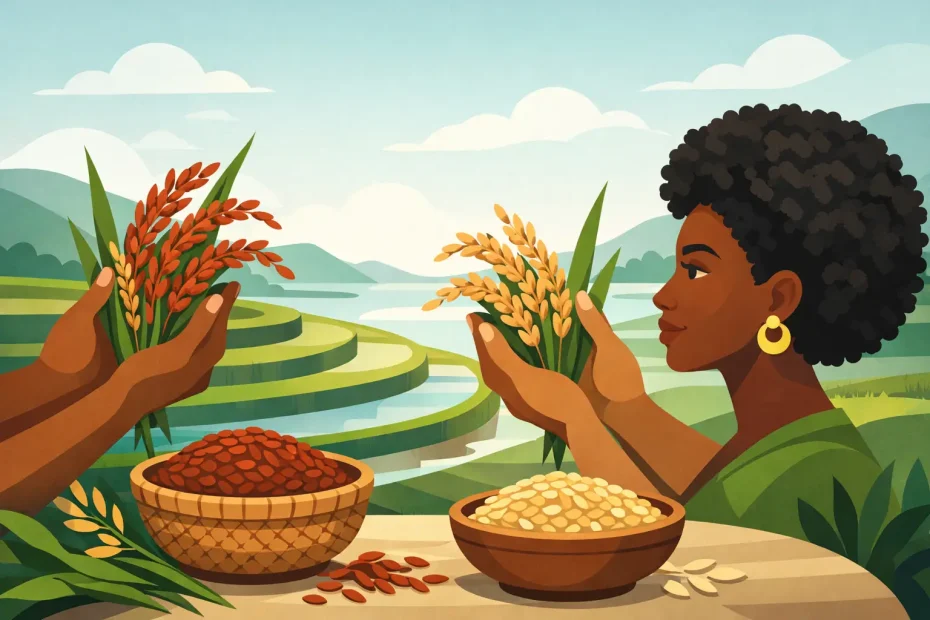
When people talk about rice, they usually mean Asian rice. But Oryza glaberrima, non-hybrid and non-industrial in many traditional growing systems, tells a very different story – one rooted in West Africa, seed sovereignty, and food traditions that existed long before modern agribusiness shaped what ends up on store shelves.
For those of us who care about ancestral foods, ingredient integrity, and culturally grounded wellness, this rice matters. It is not just a botanical curiosity. It is African rice – domesticated on the continent, adapted to local conditions, and still meaningful in conversations about biodiversity, nutrition, and how we define real food.
What Oryza glaberrima actually is
Oryza glaberrima is a species of rice domesticated in West Africa, distinct from Oryza sativa, the Asian rice species that dominates global production.
That distinction matters because it changes the conversation from generic “rice” to origin, ecology, and history.
In practical terms, Oryza glaberrima is often associated with traditional farming knowledge rather than intensive industrial agriculture.
It has a reputation for tolerating challenging local conditions, including certain pests, poor soils, and variable water environments better than many commercial rice systems built around high-input production.
BATANA OIL & ROSEMARY OIL

Why “non-hybrid and non-industrial” matters
Calling Oryza glaberrima non-hybrid and non-industrial points to how it is often understood and preserved in traditional settings. Non-hybrid generally means it is not produced as a modern first-generation cross designed mainly for uniform commercial output. Farmers can often save seed from season to season without depending on a new purchase cycle tied to proprietary breeding systems.
Non-industrial refers more to context than biology. It signals smaller-scale cultivation, local seed keeping, lower chemical dependence, and a food culture that values adaptation over standardization. That does not mean every single sample of African rice is automatically organic, heirloom, or untouched by modern markets. It means the crop carries a strong legacy outside industrial monoculture.
For communities interested in food independence, that legacy is powerful. A crop that survives because people keep planting, saving, and sharing it holds a different kind of value than one bred mainly for global supply chains.
Oryza glaberrima and African food heritage
One reason I find this rice so important is that it restores credit where it belongs. African agricultural knowledge is often overlooked, even though African farmers domesticated and sustained crops with deep ecological intelligence. Oryza glaberrima is part of that record.
This matters beyond history books. Food memory shapes wellness. The grains, leaves, roots, and oils we return to often carry cultural logic – what a region could grow well, what sustained families, and what fit the climate without excessive intervention. In the same way many of us are rethinking haircare through traditional botanicals instead of mass-market formulas, ancestral grains deserve the same level of respect.
How it differs from industrial rice systems
Industrial rice production usually favors high yields, uniform grain appearance, predictable milling behavior, and large-scale distribution. Those priorities make sense commercially, but they often narrow biodiversity. Taste, resilience, and local adaptation can get pushed aside.
Oryza glaberrima has historically been valued for something different. It may not always match the polished visual uniformity or yield expectations of industrial rice, but it offers resilience and cultural continuity. That trade-off is worth naming clearly. Non-industrial crops are not automatically superior in every category. Sometimes they produce less. Sometimes they are harder to process at scale. But they may be better aligned with local food systems and long-term biodiversity.
That same principle shows up across natural living. The most commercially optimized option is not always the one that serves us best over time.
Nutrition and whole-food relevance
Rice species are not wellness miracles on their own, and preparation matters. Still, when people seek out traditional grains, they are often looking for foods with stronger cultural ties and less industrial handling. In whole or minimally processed forms, traditional rice can fit well into a balanced diet built around fiber, minerals, and diverse plant foods.
If your interest in Oryza glaberrima is part of a broader hair and wellness journey, the bigger picture still matters most. Healthy hair is supported by consistent nourishment, not one ingredient alone. That is why I always place grains like this within a wider food-based approach, including protein, iron-rich meals, hydration, and mineral-dense staples. If you want to build that foundation, our guide to 12 Foods That Help Hair Growth Naturally is a practical place to start.
Why this rice deserves more attention
Oryza glaberrima deserves attention because it challenges a familiar pattern: African resources are often ignored until they are repackaged by outsiders. Preserving traditional African rice is part of protecting agricultural knowledge, regional food identity, and the right to define value outside industrial standards.
For readers who already choose chebe, ambunu, batana oil, or other culturally rooted ingredients with intention, this idea should feel familiar. We do not have to wait for mainstream beauty or food systems to validate what our traditions have long understood. At Jostylin, that broader philosophy is part of how I think about wellness – practical, rooted, and not disconnected from origin.
What to keep in mind if you find it
If you come across Oryza glaberrima or an African rice product described as traditional, ask better questions. Find out where it was grown, whether it is a local landrace or blended product, and how much processing it has undergone. “Ancient” and “traditional” can be used loosely in marketing.
The most useful mindset is discernment. Look for traceability, respect for origin, and context around cultivation. When a food is presented without any real story about the people or systems that preserved it, that is usually a sign to pause.
Oryza glaberrima is more than a grain category. It is a reminder that some of the most valuable wellness knowledge is not new, not industrial, and not waiting for permission to matter.