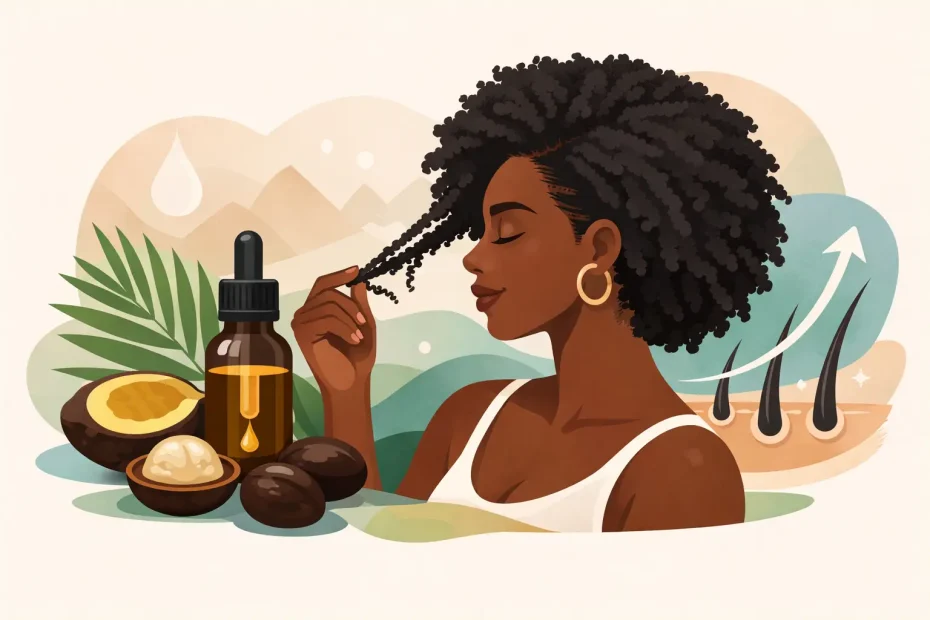
If your hair feels dry no matter how much product you layer on, or your ends keep thinning out right when you think you are making progress, learning how to use batana oil can shift your routine in a real way. I have explained properly in the video below how to use batana oil for hair growth. But I warn you first: This is not about chasing a miracle oil. It is about using a rich, traditional botanical correctly so your scalp stays nourished, your strands stay softer, and your length has a better chance of staying on your head.
You can see in the image below that I got my long hair back after it was damaged by using batana oil and various length retention techniques. Batana oil has deep roots in Indigenous and Afro-descendant beauty traditions in Central America, and that matters. Too often, ingredients like this get reduced to trends once they hit the wider beauty market. I like to approach batana oil with more respect than hype. It is a dense, nutrient-rich oil that can support dry hair, brittle ends, and scalp care, but it works best when you use it with intention.

How to use batana oil based on your hair needs
The first thing I tell people is simple: do not use batana oil the same way you would use a lightweight serum. Batana oil is heavier, richer, and better suited for sealing, softening, and conditioning than for giving a dry shine-only finish. If your hair is fine or gets weighed down easily, you will want a lighter hand.
If your hair is thick, coarse, type 4, or regularly in protective styles, you may find that your hair responds well to a more generous application.
Also be mindful of the batana oil you’re using. I use the both the Honduran and African one which you can find in my apothecary on the link below.
For most people, the easiest way to start is as a pre-shampoo treatment. Warm a small amount between your palms and work it through dry or slightly damp hair, paying close attention to the ends. Massage a little into the scalp if dryness is part of the issue. Let it sit for at least 20 to 30 minutes before washing. This gives the oil time to soften buildup, reduce that stripped feeling after shampooing, and make detangling easier.
Batana oil from la moskitia

If your scalp is flaky or tight, batana oil can also be used as a scalp oil, but moderation matters. Part your hair in sections, apply a small amount directly to the scalp, and massage for a few minutes. You do not need to drench your roots. A little goes a long way, especially if your scalp is already prone to buildup or if you use gels and edge control regularly.
In the video below, I have explained exactly how I regrew my hair after it was damaged. You can watch the video but dont forget to read the rest of the post
Using batana oil as a sealant
One of the most practical ways to use batana oil is after moisturizing. If you apply it to dry hair with nothing underneath, it can help with softness, but it will not do as much for moisture retention. Oil helps seal in water. That is why I recommend applying a water-based leave-in or moisturizer first, then smoothing a small amount of batana oil over your strands.
This method works especially well for twist-outs, braids, and stretched styles where the hair tends to lose moisture over several days. Focus on your ends first, then lightly coat the mid-lengths. You want your hair to feel supple, not greasy. If your hair looks heavy, you probably used too much.
For protective styles, batana oil can help keep your exposed hairline, ends, and scalp comfortable. That said, if you are wearing a style for several weeks, be careful not to overapply. Heavy oils can attract lint and combine with sweat and product residue. In that case, using it once or twice a week is usually enough.
How to use batana oil for hot oil treatments
If your hair is feeling especially rough, dull, or fragile, a hot oil treatment can make a difference. This is one of the best answers to the question of how to use batana oil when your hair needs deeper care.
Place a small amount of batana oil in a heat-safe bowl or bottle and warm it gently. It should feel comfortably warm, never hot. Apply it to sectioned hair from scalp to ends, then cover your hair with a plastic cap and let it sit for about 20 minutes. You can wrap a warm towel around your head or sit with a hooded dryer on low heat if that is part of your routine.
Afterward, shampoo thoroughly and follow with conditioner if needed. Your hair should feel softer and more flexible, not coated. If it feels waxy or overly heavy, you may need to clarify on your next wash day or use less oil next time.
Can batana oil help with hair growth?
Batana oil does not make hair grow overnight, and I do not believe in selling that fantasy. Hair growth starts at the scalp, but retention is what most people are really after. If your hair is constantly breaking, shedding from stress, or drying out at the ends, growth becomes harder to see.
What batana oil can do is support a healthier environment for retention. A nourished scalp is less likely to feel irritated or neglected. Softer hair is less likely to snap during detangling. Sealed ends are more likely to hold onto moisture. That combination can help you keep more of the hair you grow.
If growth is your focus, consistency matters more than excess. A simple routine tends to work better than an overloaded one. Use batana oil as part of a regular wash day, scalp care routine, or nighttime sealing step and give your hair time to respond.
Batana oil for different hair types
Textured hair often does especially well with richer oils, but the way you use them should still match your strand size, density, and styling habits. If you have type 4 hair that shrinks heavily and dries out fast, batana oil may feel supportive right away. It can help reduce roughness and protect the hair after moisturizing.
If your hair is low porosity, the experience can be different. Heavy oils sometimes sit on top of low porosity hair rather than absorbing well. In that case, use batana oil in smaller amounts and apply it to damp, warm hair after a water-based product. A hot oil treatment before shampooing may work better than daily use.
For relaxed, color-treated, or heat-damaged hair, batana oil can help with softness and breakage control, but it should not replace protein or other reparative care if your hair is structurally weak. Oil can support damaged hair, but it cannot rebuild it.
How often should you use batana oil?
This depends on your routine. If your hair is very dry, once or twice a week may be helpful. If you wash often, you might use it as a pre-poo before each wash. If your scalp gets oily or irritated easily, once a week or even every other week may be enough.
I usually suggest starting with one method instead of using batana oil everywhere at once. Try it first as a pre-shampoo treatment for two to three wash cycles. Then pay attention. Is your hair softer after cleansing? Are your ends easier to detangle? Is your scalp calmer or more congested? Your results will tell you whether to increase, reduce, or change how you use it.
Common mistakes when using batana oil
The biggest mistake is using too much. With rich oils, more is not better. Excess oil can leave hair limp, make cleansing harder, and create scalp buildup.
Another mistake is applying it without moisture underneath and expecting long-lasting hydration. Batana oil is excellent for sealing and conditioning, but it is not a substitute for water.
I also see people use a good oil inconsistently, then expect dramatic results. Traditional botanicals usually reward steady care, not random use. A simple routine done regularly will carry you further than a shelf full of products you barely touch.
What to expect from a good batana oil routine
A good batana oil routine should leave your hair feeling softer, more pliable, and less prone to snapping during wash day. Your scalp may feel more comfortable if dryness has been an issue. Over time, you may notice better length retention because your ends are staying in better shape.
What you should not expect is instant density, overnight regrowth, or a replacement for a complete hair routine. Cleanse your scalp, condition your hair, protect your ends, and manage tension from tight styles. Batana oil fits into that bigger picture. It does not do all the work by itself.
For women building a more intentional routine with traditional botanicals, batana oil is worth learning properly. At Jostylin, I see it as one of those ingredients that makes the most sense when you stop treating it like a trend and start treating it like a practice. Use it patiently, use it according to your hair’s actual needs, and let your routine become more grounded with time.