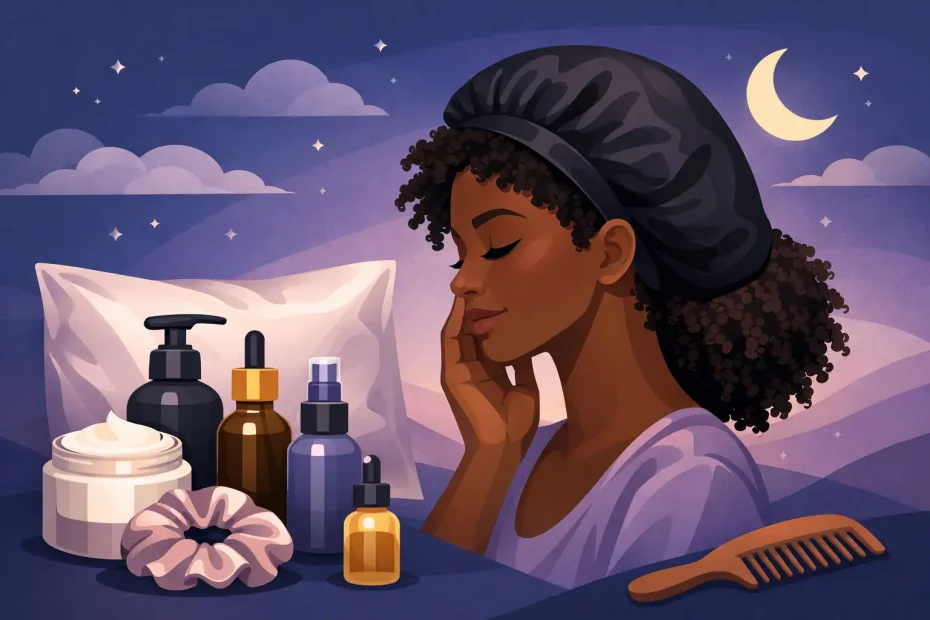
You can have a solid wash day routine and still lose moisture overnight. That is why choosing the best nighttime products for 4C hair matters so much. Night care is where a lot of length retention either holds up or falls apart, especially if your strands are dry, fragile, tightly coiled, or styled in twists, braids, or a stretched look.
I do not think of nighttime haircare as extra. For 4C hair, it is maintenance in the most practical sense. Cotton pillowcases pull moisture, rough fabrics create friction, and heavy products can leave hair limp or sticky by morning. The goal is not to use more products. The goal is to use the right ones, in the right amount, for what your hair actually needs before bed.
What makes nighttime products work for 4C hair
4C hair usually thrives when moisture retention, low manipulation, and friction control work together. A product can be rich and still fail at night if it leaves buildup on the scalp or makes your twists tacky. On the other hand, a lighter formula can work beautifully if your hair is already hydrated and just needs help staying that way until morning.
That is the real standard I use when thinking about the best nighttime products for 4C hair. They should either help preserve moisture, reduce mechanical damage, calm the scalp, or support protective styling. Some do more than one job, but very few products do everything well.
1. Water-based leave-in conditioner
If your hair feels dry by bedtime, a water-based leave-in is usually the first product worth reaching for. This matters because moisture starts with water, not oil. A good leave-in gives your strands hydration and slip without forcing you into a full rewash.
For 4C hair, I look for leave-ins with ingredients like aloe vera, glycerin, marshmallow root, or panthenol, especially when hair is in twists or loose sections. The trade-off is that too much leave-in at night can cause shrinkage or make an old style frizz up. If you are preserving a stretched style, use a small amount on the ends and driest areas only.
2. Lightweight hair butter or sealing cream
Once moisture is in the hair, sealing becomes the next step. This is where a lightweight butter or cream earns its place. It helps slow moisture loss overnight and can soften dry ends that tend to knot or snap.
The key word here is lightweight. 4C hair can handle rich textures, but nighttime is not the best time to pile on thick product that leaves residue on your scarf or clogs the scalp. A balanced butter with natural oils and plant-based emollients can support length retention without making hair greasy. If your strands are low porosity, use less than you think you need.
3. Batana oil for dry lengths and ends
Batana oil has become one of the more talked-about oils in natural haircare, and for good reason. On 4C hair, it can be especially useful at night when your ends feel rough, overhandled, or weak. I like it most as a finishing seal over a leave-in or as a small amount pressed into the ends before twisting.
It is not a replacement for hydration, and that is where some people get disappointed. Oils do not moisturize dry hair on their own. What batana oil can do is help reduce moisture loss, add softness, and give older protective styles a little more flexibility. If your hair is fine or your scalp gets congested easily, keep it off the roots and use it mainly on the shaft and ends.
4. Scalp serum or light botanical oil
Night is also a good time to support the scalp, especially if you wear protective styles, deal with dryness, or notice itchiness after a few days. A scalp serum or light botanical oil can help soothe tension and dryness without disturbing your style too much.
This is where lighter is usually better. Heavy oiling every night can lead to buildup, especially if your scalp is not being cleansed often. I prefer a few drops massaged into problem areas instead of coating the whole scalp. Ingredients like rosemary, peppermint, tea tree, or neem can be helpful, but they need to be used with care. Strong essential oils can irritate sensitive scalps if the formula is too aggressive.
5. Satin or silk bonnet
A bonnet is not a styling product, but it absolutely belongs in any real conversation about the best nighttime products for 4C hair. If your haircare ends with good product application and no friction protection, you are leaving the job half done.
Satin and silk help reduce the rubbing that leads to dryness, frizz, and breakage. They also help your products stay on your hair instead of on your pillow. The main difference comes down to feel, cost, and preference. Silk is often more breathable and luxurious, while satin is usually more affordable and accessible. What matters most is consistent use and a fit that does not slip off halfway through the night.
6. Satin pillowcase as backup protection
If you move a lot in your sleep or your bonnet never stays put, a satin pillowcase is not optional. It is your backup layer. I always see it as insurance for your routine.
A pillowcase alone will not hold your style in place the way a bonnet or scarf can, but it does reduce friction and moisture loss compared with cotton. It is especially useful for people wearing twist-outs, braid-outs, puffs, or stretched styles that need a bit more room. If you can use both a bonnet and a satin pillowcase, even better.
7. Satin scarf for edges and laid styles
There are nights when a bonnet is too loose and a scarf does the better job. If you are trying to preserve edges, smooth a puff, flatten roots, or keep a protective style neat, a satin scarf gives more control.
This matters because 4C hair often needs compression as much as coverage. A scarf can help set mousse, keep front sections from frizzing up, and reduce the daily need to restyle. Just make sure it is snug, not tight. Too much tension around the hairline works against the very growth you are trying to protect.
8. Mousse or foam for maintaining twists and braids
Many people think mousse is only for styling, but it can also be useful at night when you need to refresh braids, twists, or a roller set without overloading the hair. A light foam can tame frizz and help your style keep its shape under a scarf.
The caution here is alcohol content and overuse. Some foams dry the hair out if used too often, especially on exposed 4C strands that already struggle with moisture retention. I use this type of product more strategically than nightly. It is best for style preservation, not hydration.
9. Chebe-based or length retention butter for protective styling
If your hair stays in twists, braids, or low-manipulation styles for days at a time, a chebe-based butter or length retention butter can be a strong nighttime option. These types of products are often chosen for helping coated strands stay lubricated and less prone to snapping during manipulation.
They are not ideal for every routine. If you wear frequent wash-and-gos or prefer very light products, they may feel too rich. But for stretched 4C hair, mini twists, and long-term moisture support, they can work well when used sparingly. At Jostylin, this is the kind of culturally rooted product approach that makes sense to me – not because it is trendy, but because it aligns with how many of us already care for textured hair over time.
How to choose the right nighttime product combination
You do not need all nine products. Most 4C routines work best with a simple combination based on your current style and your hair’s condition. If your hair is loose and dry, a leave-in plus a sealing butter and bonnet may be enough. If your hair is in twists, you may get better results from a little oil on the ends, a scalp serum where needed, and a satin scarf to hold everything in place.
Climate matters too. In dry weather, richer creams and butters often make more sense. In humid weather, lighter layers help prevent product overload and sticky hair. Porosity matters as well. Low-porosity hair usually prefers lighter application and more attention to product buildup, while high-porosity hair may need more sealing support to hold moisture overnight.
What to avoid before bed
Some products create more problems than they solve at night. Heavy gels can leave hair stiff and vulnerable to breakage if you sleep on a style the wrong way. Thick grease on the scalp can trap buildup. Too much oil can make hair feel soft at first but still dry underneath.
I would also avoid the habit of reapplying multiple products every single night without checking what your hair really needs. 4C hair benefits from consistency, but it also benefits from restraint. Sometimes the best nighttime routine is a light refresh and proper protection, not a full restyling session at 10 p.m.
Healthy 4C hair is often built in quiet moments like this – twisting gently, sealing the ends, covering your strands, and letting simple habits do their work. If your nighttime routine feels supportive instead of exhausting, you are much more likely to keep it, and that is usually where the real progress starts.